I’m a psycholinguist specializing in second language reading development. I work as a Research Associate with the MELD program at McMaster University, and as a Research Fellow at the College Student Success Innovation Centre (CSSIC), a partnership between McMaster University and Mohawk College in Ontario, Canada. I also serve as co-editor of The Mental Lexicon.
You can find my published work below - projects I’ve been lucky to work on with an incredible group of researchers, mentors, and colleagues over the years.
PhD in Cognitive Science of Language, 2016
McMaster University, Canada
MSc in Developmental Linguistics, 2011
University of Edinburgh, UK
BA in English Language and Linguistics, 2010
York St. John University, UK
My primary research interest is in reading development. I use a variety of tools, including eye-tracking and quantitative linguistic methods, to delve into how linguistic, cognitive, and experiential factors influence reading behavior.
My current research focus is on individual differences in the development of reading skill among international students who use English as an additional language. This SSHRC-funded research project examines longitudinal change in reading skills among international students enrolled in McMaster University’s pre-sessional English for academic purposes (EAP) programs.
As Mohawk College’s College Student Success Innovation Centre (CSSIC) Research Fellow, I am investigating literacy development among international students enrolled in Mohawk College’s EAP program. This research project involves implementing and testing a targeted reading intervention which is aimed at enriching the academic English skills of international students at Mohawk College. You can read more about CSSIC and about the project here.
Here are some projects that have recently been published.

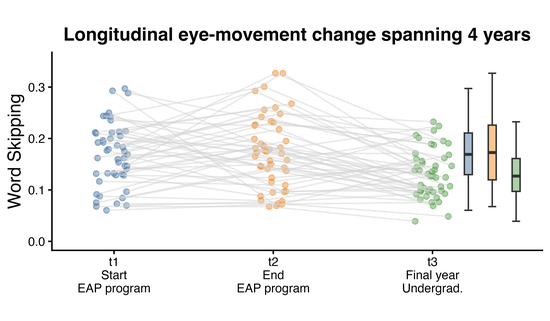
How does English reading development unfold after a bridging (EAP) program ends? We followed the same international students across ~4 years and used eye-tracking to watch L2 reading development unfold in real time. We asked: Which skills grow fastest during the EAP program, and which changes persist (or shift) once students move into undergraduate study? The figure shows one example—word skipping—across three timepoints. This project was published in Reading and Writing.

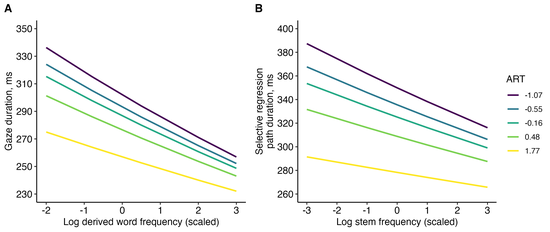
DerLex is a large open database of eye-tracking data on English derived words (e.g., teacher, permission). It’s designed as a companion to CompLex—our earlier eye-tracking megastudy of English compound words (e.g., goalpost)—so researchers can study two major types of morphological complexity using comparable methods and compatible data structures. This project was published in Behavioral Research Methods.

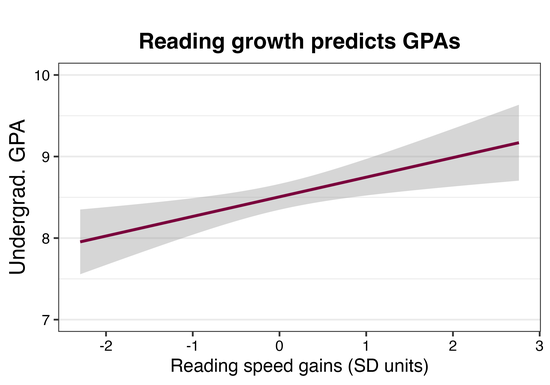
Universities often run intensive English “bridging” programs for international students who are academically ready, but still building English proficiency. In this project, we tracked 405 students across a 28-week English for Academic Purposes (EAP) program and asked a simple question: Do the reading gains students make before they start university actually matter later on? Using a Random Forests approach plus regression modeling, we found that growth in silent reading fluency (words per minute) was a standout predictor of later undergraduate GPA. Roughly, a 1 SD boost in reading-rate growth (~26 WPM) predicted about a 0.21 increase in GPA. This project was published in Reading and Writing.

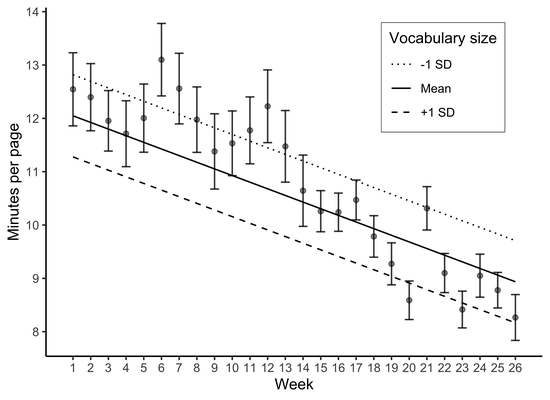
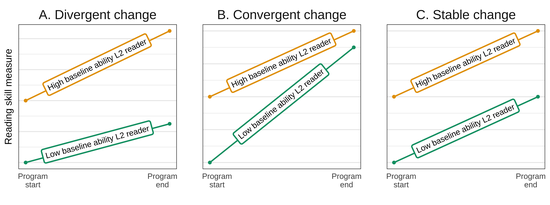
Do students with lower incoming reading scores catch up during an English-for-Academic-Purposes (EAP) bridging program—or does the gap stay the same? We tracked 405 Chinese-speaking students across a 28-week program using eye-tracking during passage reading plus comprehension questions. Using incoming IELTS Reading scores as a baseline, we found clear overall improvement in reading efficiency and comprehension—but the growth trajectories were parallel across ability levels, meaning the gap neither widened nor closed (a stable change pattern). This project was published in Bilingualism: Language & Cognition
I have taught the following courses at McMaster University:
(2023, 2025, 2026). In this course students collaborate to plan, carrying out, analyze, and report an experiment that addresses a cognitive aspect of language processing.
(2017, 2019, 2020, 2021, 2022, 2026). An introductory course to statistical methods custom-tailored to the needs of language researchers. This course provides an introduction to R, a free software environment for statistical computing and graphics.
(2018, 2020, 2021, 2024, 2025). This course studies computational tools and techniques of language processing using large electronic collections of texts. Students are trained in basic text-processing, statistical and programming skills using R.
(2017). This course offers senior undergraduate students the opportunity to participate in a learning-centred leadership program, involving peer-to-peer mentoring of students in the MELD program. The course provides up-front and on-going training and development in active leadership and mentorship.
R, Shiny, ggplot, Markdown
LMER, longitudinal analysis, growth curve modeling
Evidence-informed pedagogy
Programming: EyeLink, PsychoPy, Java, DMDX; Platforms: Pavlovia, Inquisit, GitLab, Amazon Turk, DMDX
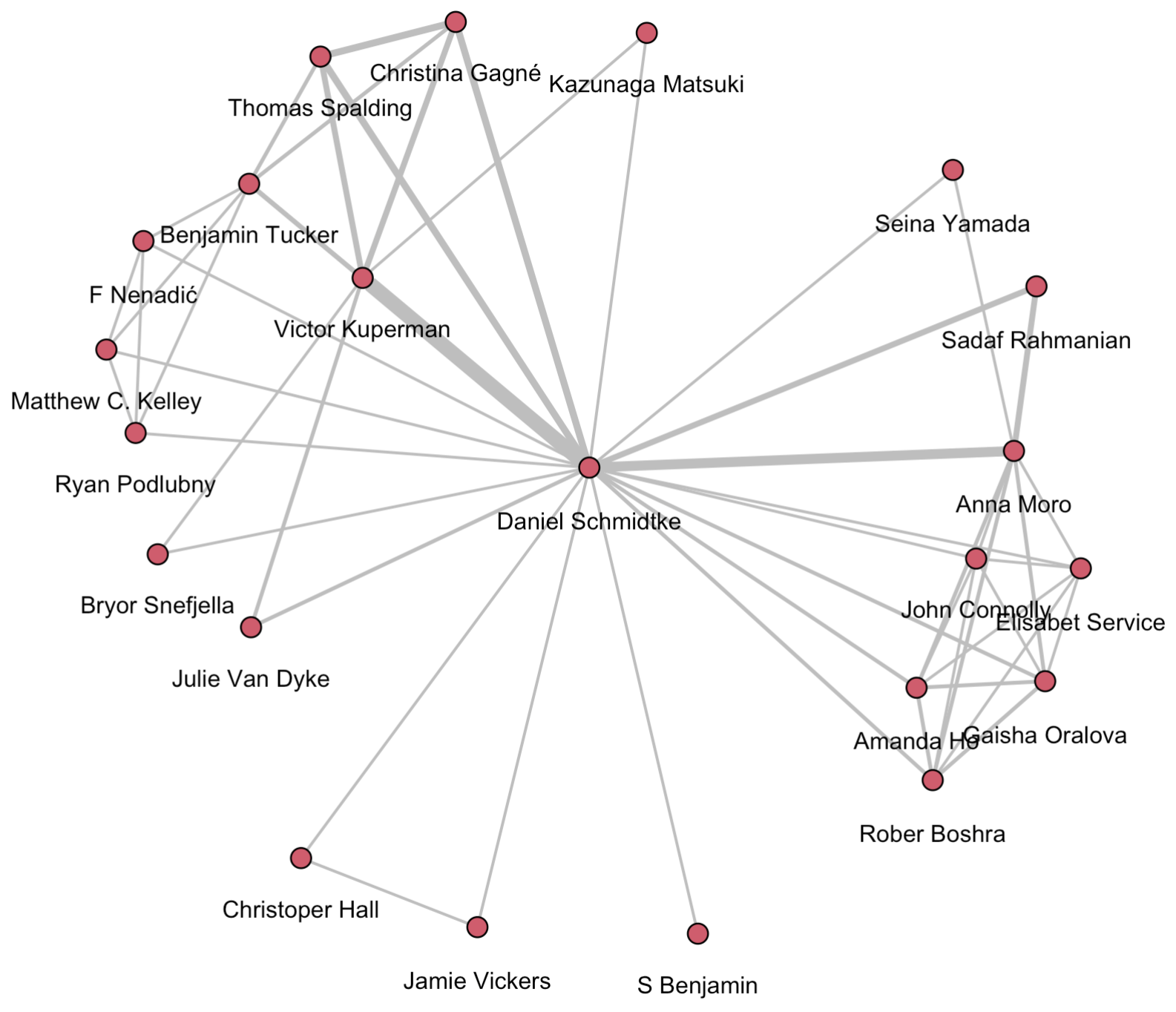
Line thickness corresponds to the number of co-authorships.

An article about my current work at the MELD program at McMaster University
A selection of news articles related to our Twitter study: